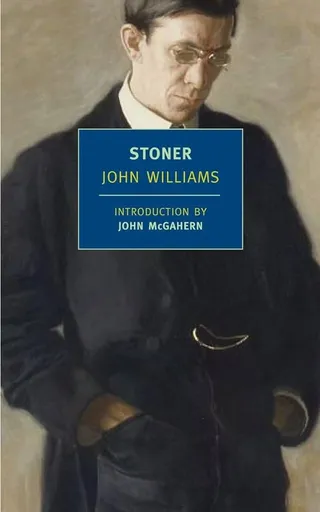


You'll read this and recognize your own life. Simultaneously, you'll be grateful that yours is not quite this empty. You've heard this about Stoner before.
The plot is ordinary, you know this. William Stoner is born to farmers, goes to college, falls in love with literature. He becomes a professor. Marries the wrong woman. Has an affair. Ages. Dies.
What stood out to me is that Stoner is almost unique in his lack of interest in self-expression.

We tend to think of authenticity as something to be discovered and think it inherently false if shared. Stoner does neither discovery nor sharing. He rarely articulates what he wants and seems only faintly curious about his own psychology. His deepest experiences are things he submits to.
When he encounters literature, it draws him into something larger and older than himself, rather than allowing him to find his voice. In that sense, the novel feels almost medieval or Catholic; its highest moments are of surrender; it's composed of grace, vocation, and submission.
This is why I've always thought the title ironic. The novel is called Stoner, but the man himself is constantly disappearing. Stoner's marriage overwhelms him. The university absorbs him. Literature absorbs him. Love absorbs him.
And here I must point out the obvious: most of us subconsciously believe suffering creates a character, a life arc. Stoner suffers constantly, but his suffering never paints a grand arc, whether tragic or heroic. He just is, he just lives, as we all do.
The novel is thus about devotion. Stoner's great virtue is his ability to remain attentive to things that cannot reward him. He gives serious attention to everything that doesn't love him.
Most of us secretly believe our lives will be justified retrospectively. That the story will eventually reveal what it was all for. Stoner rejects this.
Yet Williams suggests something equally important: a life may possess meaning without possessing significance or even satisfaction. Significance is public; meaning is private. Stoner achieves almost none of the former and a good deal of the latter. After all, he was encompassed and overwhelmed by life.
He is not a great man or a remarkable one. What makes him worthy of attention is his capacity for devotion. Williams' achievement is to treat that devotion as sufficient.
The distinction reminds me of a small chapel I saw in Tallinn. I noticed it only because it stands on a crowded tourist route. The chapel's existence and quiet devotion, however, is independent of that attention the bustle grants it. It is nobler for ignoring us as we gaze at it. Stoner treats its protagonist similarly: we notice him because Williams directs our gaze, not because Stoner demands it.
And in doing so, Williams asks a question modernity has almost forgotten: what if devotion matters more than accomplishment?


This is the best review of Stoner I have read, for the fact that it succeeds in shedding new light on a book I've been analysing for many years; Stoner's quiet devotion to a pursuit that cannot reward him is perhaps the very reason I find this book so affecting. Some years ago, when the Cassini–Huygens probe ended its mission by plunging into Saturn, I would become very emotional in a way inexplicable to me whenever I thought of the probe's fate, until now I realise I have perhaps managed to project the same devotion on to the life of such an object, orbiting in silent space.
Thank you so much! I'm really flattered. It's funny you mention Cassini because I used to follow Spirit's updates, way back when I was a kid, and her death is what inspired me to study physics. It never occurred to me that was a similar sort of devotion.