
Karl Ove, perhaps more than anyone alive right now, has been blessed with great patience. The inability to take anything in the world for granted no matter how small and insignificant. His instruments of observation are perfectly tuned to a world that he sees filled with wonder. But his really rare skill is the ability share the insights of that patience outward. He has this tremendous capacity to show something, anything, and say “look, look closer, there’s more here, if you just let yourself sit with this for a moment you’ll see that it contains the universe.” And it doesn’t really matter what it is that he shows you. In A Time for Everything, what he’s showing the world is the human nature and reality of mythological figures.
If his assertions in My Struggle around the writing of A Time for Everything are to be believed, then this book was the first time he truly felt that he was able to perform this magic. He learned to regimen this time in a way that allowed it to open up to the infinite for him. Was that all it took for him to activate this latent power of vigorous observation? For the deep and trusting descriptions of little phenomena that he sees in the world to be given life like a seventeenth century philosopher?
Certainly it seems from the narrative structure that this novel might be his effort to embody patience in a complete and meaning-seeking way. The flow of the apparent story is interrupted by hundreds of pages of digressions. Philosophical essay-like passages, considerations of seventeenth century natural history texts, and retellings of between-the-line moments from the Old Testament which themselves nest like Matryoshka dolls. These are all given room to breathe and bloom as the story of Antinous Bellori, a fictitious Renaissance writer who spent his life writing about angels unfolds between the margins of the sweeping fabricated treatise On the Nature of Angels. Karl Ove delivers the story with an unshakable, palpable confidence. There is patience in every line and every detail feels real, valid, never unnecessary. He’s trying to share the real feeling of being in the world as he writes.
And luckily, even if his one of a kind ability to convey his world isn’t shareable, the world that he’s describing is. This sharing is the core of fiction, of art in general: creating an experience that helps us live more completely in the world. This is why we read. It’s a paradox. We want to become closer to a world and a feeling that can never be conveyed within the pages of a book. But the book itself can become such an experience.
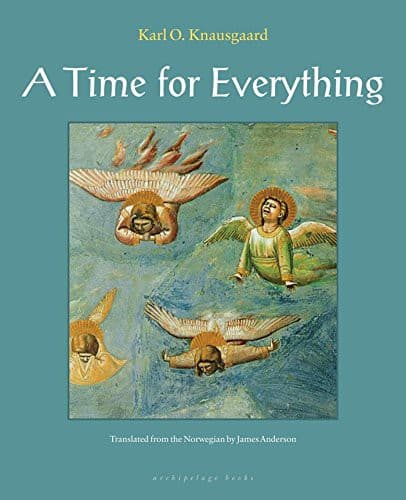
It’s funny as I think back on A Time for Everythjng. Across the board it’s Knausgaard playing his greatest hits from the start. He’s in his wheelhouse. The subject matter is all there. The corruption of the sacred and the irreversible creep of the profane into the modern world. Internality vs externality. Christianity’s fascinating place in the sphere of ideas and philosophy. It’s all there from the jump except for two notable exceptions that don’t make their way in until near the end. The first is a lack of art analysis. For most of its run A Time for Everything seems more interested in analyzing texts from antiquity and their authors than art. That holds until near the end of the book when the narrative is forced into confrontation with Giotto’s Lamentation on the Scrovegni Chapel ceiling. The painting serves as a jumping off point to discuss history’s evolving interpretation of the Angel as a subject of art only after the narrative has earned the right to wax philosophic on the art. And from interviews that he’s given, this meditation is actually the original idea that seeded A Time for Everything. The painting also serves as the cover of the Archipelago edition of the book in a fun Idealist meta nod to the reader.
The second exception to Knausgaard’s typical structure is that A Time for Everything is almost entirely in the third person. He writes of a world that he is observing rather than participating in it. All of the thoughts described in his characters are projected into them and their interiority is manufactured, a conjurer’s trick.
But in the end real life intervenes. Knausgaard almost seems forced to end his breakout novel in the first person, just as Joyce did in The Portrait of the Artist as a Young Man. He finds himself at home in Norway in the 80’s. However much the world is an existing, alien thing, to write about it is to be uniquely grounded in it. A Time for Everything, as much as it exists in its own bounded volume, serves as a beautiful introduction to the internal world that would be exposed in what came after. In hindsight, like with all natural phenomena first experienced as a strange miracle, it seems inevitable. But for Karl Ove it must’ve seemed anything but inevitable. Like everything else in the world it was one moment, then another, then another. Each perfect in its own way and only knowable as a whole with the help of history.