
My diving bell becomes less oppressive, and my mind takes flight like a butterfly.
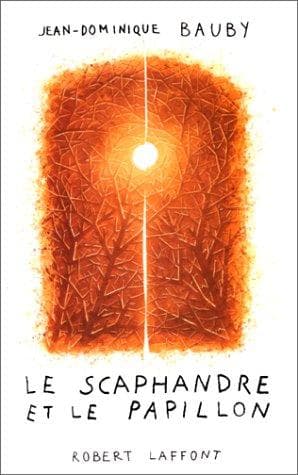
Le Scaphandre et Le Papillon [The Diving Bell and the Butterfly] (1997) is a memoir whose extraordinary circumstances resemble that of a moral fable. Jean-Dominique Bauby had everything you might want as a 43-year old man––a loving partner, sweet children, a successful career, a life of glamor and adventure in Paris––when a sudden stroke leaves him almost completely paralyzed, able to move little more than the upper part of his face. In his capacity as editor-in-chief of Elle magazine, he had previously secured a book contract with Éditions Robert Laffont, and though he is only able to control but one of his eyes, his cognitive faculties are intact, and Bauby is determined to fulfill this obligation from his hospital bed on the sandy shores of Berck. Over the course of two months, he blinks out each letter of this 100+ page book (~200,000 blinks) with the aid of his amanuensis Claude Mendibil, sent by his publisher, reflecting on his present and past life with sincerity, humor, and aplomb.
The very act is inherently inspiring. A man of letters, refusing to go gently into the good night, summoning all his powers to broadcast a message to the world. was an instant bestseller in France, and has since sold millions of copies around the world. It has some great moments and makes me want to visit Berck-sur-Mer, more than any painting or photo. There is even a halfway decent movie adaptation, if you can look past the usual mountain of liberties taken with the truth. But what surprised me was the actual content of the book; it made me sad, not for his luck or his situation, but for the overwhelming sense I got from it, that he was confined long before time and circumstance reduced his distance from the walls to zero.


Not to take away from the emotional lessons but the concurrent development of endovascular therapy for strokes is also interesting.
The first endovascular thrombectomy occured the year before the author's 1995 stroke in 1994 and trials for endovascular thrombectomy of basilar artery strokes (the classical cause of locked in syndrome) didn't occur until the early 2000s to mixed results, and only saw strong and true success in the late 2010s with the development of stent retrieval devices.
It's an dark but somewhat interesting thought to wonder if the story would be as emotionally compelling if the events occured a decade later where he received a somewhat successful intervention restoring some function and leaving him only a half cripple. Of course anyone would likely prefer more function to an emotionally resonant story, but it's thought provoking to consider the consequences of medical advancement.
That's a very interesting piece of historical context, thanks for the insight! I had no idea there were such dramatic medical advances in this very area.
I did wonder a little about how much of the reaction to the book can be attributed to the severity of Bauby's condition. You bring up a great point. Would the book be less affecting if he had more function? I can certainly see this as far the movie is concerned, but at least on a personal level, I managed to finish the book before delving more into his backstory for things like this review and hadn't heard of Bauby beforehand. I do feel the need to emphasize that the quality of the writing is unusually high for a book of this type. I guess there is some qualitative difference in someone who works with words for a living when it comes to these things. I compare this to something like When Breath Becomes Air which I think was more touching in that obvious American/Hollywood way but whose writing was far worse (barring the heartbreaking chapter by Kalanithi's wife). I find it easy to imagine that a mere "half-cripple" Bauby would more than be able to overcome the "relative aura loss" by writing an even better book.
I'm curious how the book was marketed in France, especially in the mid-90s, when Bauby being the editor-in-chief of a major magazine was probably a much bigger deal than we can imagine today. I feel like another big contributor to its popularity in France is that the mother of Bauby kids is Sylvie de la Rouchefoucauld, who not only works in public relations––and likely had a heavy hand in the movie script, where she has an outsize role in contrast to two lines she gets in the book––but who also hails from one of most famous families in France. It's perfect tabloid fodder and the kind of news item that I can easily see being a national conversation topic.