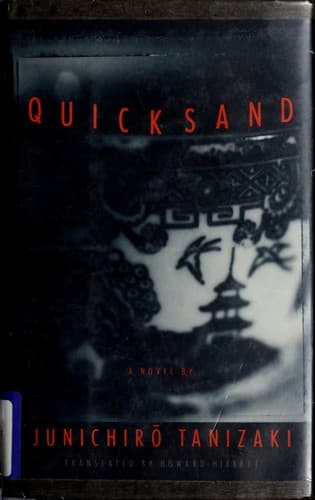

In 1920s Osaka, an upper middle-class married woman named Sonoko meets and falls in love with Mitsuko, the seductive daughter of a wealthy merchant family. Through Mitsuko she's drawn into a world of secrets, lies, scandal, and constant double and triple-crossing; unsure of where she stands with her vain and capricious lover, while trying to navigate her crumbling marriage and the machinations of Mitsuko's duplicitous fiancé. The story spirals into absurd levels of obsession, jealousy and deceit as the fiance and Sonoko's mild-mannered husband become embroiled in their illicit love affair.Similar to Tanizaki's Naomi, Quicksand shows how one-sided obsession, which pursues beauty as an object, will always result in self-destruction. Confusing sexual obsession for mutual love is the 'quicksand' that drags you to your death because you blindly mistook it for stable ground.The book also has at its center a similar narcissistic young love idol, Mitsuko/Naomi, who does not love in return but only desires to be loved for their own gratification, a reflection of their value and power. Tanizaki definitely got burned by a beautiful girl at some point in his life and just couldn't let it go.I liked Naomi a lot so was a little disappointed with Quicksand, which is more interesting for its context than its storytelling. A Fatal Bisexual Quadrangle written in Japan in the 1920s?? Sounds fascinating on paper, but the story itself is both too bloated and too straightforward. It comes out as a sort of pulpy, silly detective story trying too hard to be dramatic, though with occasional moments of effective atmospheric tension and some interesting explorations of sexual psychology.Worth reading for the novelty of its historic context - particularly how bluntly the topic of homosexuality/lesbianism is treated - but I wasn't blown away or even particularly moved by anything in it.


Though I understand why it had to be changed, the original Japanese title was one of the most elegant descriptions I've ever seen of a book's contents. That Tanizaki so valued the formal or structural aspects of story makes it especially apt.