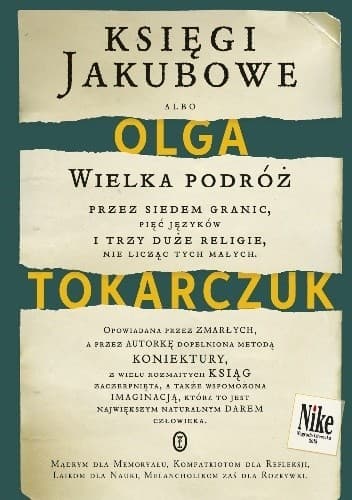

DNF'd at ~ 250 pages (i.e. end of Book of Sand)
Not so much a bad book as an exhausting one, and I don't mean in scale. Olga T is desperate to impress (or maybe desperately impressed?); not a page goes by without her riffling through her bag of tricks for another framing device or off-shooting plot layer or cutesy imagistic twist; it's so self-consciously masterpiece-shaped that it barely has time for anything but pyrotechnics. The book isn't meandering so much as it is so sure of the awe-shatteringly compelling nature of its every word that it believes it has earned every moment of its own indulgence. More authors should yield to this level of megalomania; we are in serious need of more ecstatic writer egos. But I'm not the kind of reader for whom that can power the entire ship for longer than a few hundred pages. The signifiers of thoughtfulness are not enough for me to hold faith that thought will eventually come. Maybe I'm just impatient, and I'll hold that L, but I truly believe overdetail is not a virtue for its own sake; if anything, it's a crutch, and you can blame Borges for that opinion. Does the sheer weight of character and psychology eventually coalesce into some worthwhile exploration of the never-ending human fear/awe of the new? I won't pretend it's impossible, and many people smarter than I would happily call this among the century's great works. But I'm past the point in my life where I believed finishing a book was the only valuable way of engaging with it, so I'm reaching out: Should I persist? Will I find the rest of this worthwhile if this is the reaction I'm having to its first quarter? Should I look elsewhere to another of Tokarczuk's books to better acclimate to her voice? Should I stop giving her the time of day after she publicly confessed to calling her intellectual fleshlight 'darling'? Phones are open.


I love Borges, but I think he was wrong about detail, personally speaking. For one, Bolaño is basically Borges with "overdetail" and I think 2666 is absolutely amazing.
I've yet to read BoJ––it's near the top of my list for the next big book I want to tackle––but I liked Drive Your Plow over the Bones of the Dead (though not life-changing) and got me to look at BoJ, which seemed much more interesting to me. Maybe that's one way, if you're looking to dive back in? If you're looking for style, I've heard this and Primeval And Others Times are pretty consistent in writing; but if it's that which annoys you, I'm not sure if it'd be much better in smaller form. Personally, I can forgive more messiness if they're swinging for the fences.
I feel like Tokarczuk is very much a try-hard, and I mean that in the best possible way. I think to a modern savvy book reader, this can come off as "cringy," and I feel those that defuse this earnestness with irony or humor––e.g. DFW with Infinite Jest, Bolaño with 2666, which are often compared to BoJ––are more palatable. It probably also helps that these two novels are at least set somewhere more familiar, with IJ rooted in US pop culture and the backdrop of 2666 being US/Mexico border tensions; they are much more easy to understand than Jewish life in 18th century Poland for a typical Anglophone. I think it's crazy that a book like BoJ was a bestseller in Poland in the 2010s––it gives me a lot of hope for literature in the 21st century––but it probably helps a lot that the setting and issues are much more close to home for them.
Not sure if you're a history or religion/philosophy buff, but Jacob Frank is a real person with a very interesting backstory. I've also heard that for BoJ it helps to know a little about Jungian psychology, especially as Tokarczuk is a trained Jungian psychoanalyst. The collective unconscious is supposed to be sort of the medium for the developments in the book; Jacob Frank is a representation of the shadow; the daughter is supposed to be an anima/animus; etc. Ancient disciplines like alchemy are not viewed as useless pseudoscience by Jungians; useless as a science, yes, but they contain amazing psychological discoveries. They weren't changing lead into gold, but they discovered a startlingly accurate representation of their own minds that they projected onto alchemical objects and concepts; in particular, unbeknownst to them, they discovered the process of individuation, which is the fundamental goal of Jungian psychodevelopment. Ditto for Jewish mysticism (e.g. Kabbalah, Sabbatai Zevi), though I know a lot less about that. Again, to me it's crazy that this book took off the way it did. I don't think you need to know all this to enjoy the book––maybe just reading a couple background summaries or articles is likely enough––but it's supposed to be a very deep, very psychological exploration of the Frankist movement, a very weird chapter in history that's a shining example of life being stranger than fiction.
No shame in DNF. Lord knows I myself had to get to a certain time and place in my life for certain books to resonate. But the reasons above are at least why I'm very much looking forward to reading Books of Jacob someday.
I hope I get to hear your thoughts on it; no doubt they'll be more considered and thoughtful than what I've plastered above. I firmly believe that dropping a book is not a surrender but a retreat, so bearing that in mind, where might you recommend I look to re: Jung, or maybe even some dryer non-fiction on Jacob, if I were hoping to colour some of the details of the work with more significance next go around? Or maybe, as I did with DFW back when, I should have just started with Plow and let her win me over before I dove headfirst into the work with the much higher buy-in. Thanks for the reply!
Thanks, and I do like your review; any honest reaction is more than worthy, and I'm a reader just like you. In this case, somebody just happened to tell me about this book in a way that hooked me.
I think the Jungian reading of BoJ isn't a necessity––the handful of mainstream reviews don't mention that aspect at all, though there are more than a few just outside of it that do––but, for example, the behavior of Jacob is almost textbook trickster archetype (e.g. compulsive boundary pusher in everything) and the relationship with his daughter as anima/animus is supposed to be a kind of organizing principle for why they act the way they do. It's also supposed to work on a surface level as a straight story, I think, but from the few sections I thumbed through, it's a little overwhelming even with the short chapters. For some people (like me), it helps to have some sense of where the author is trying to go and I know that at least for Tokarczuk, this a deep well that she seems to return to in all her writing. I've heard things like keeping a character list helps on practical level too, like with War and Peace.
For Jacob Frank or Frankism, I know nothing special here, but even the relevant Wikipedia pages are real rabbit-holes, leading everywhere from the origins of the Hebrew alphabet to present-day conspiracy theories. You can probably just follow your nose as to where and how far you want to go.
There's a lot of places to start with Jung, depending on your personal background and interests, but an accessible overview is Man and His Symbols, which was mostly written by his students (which helps, because they had to learn it themselves). But another way is just to pick a topic you like (e.g. myths, dreams, astrology, medieval philosophy, neuroses, etc.) and just read the relevant writing by Jung on it; it's a surprisingly coherent theory and Jung seemingly applied it to everything; you can fill in any background easily because the same themes keep showing up. In lieu of that, Answer to Job is the classic starting point for Jungian thought, probably the shortest self-contained application by the man himself and is a good intro mostly because the story is so well-known (and easily readable if not).
If you want a really easy introduction to Jung for a more literary or pop culture audience, you could watch or read some Joseph Campbell (e.g. The Hero with a Thousand Faces), who I found first and thought was brilliant (he's a good read, if only because it's easily relatable), before realizing he was just cribbing his ideas from Jung and doing a poor job at that. Campbell doesn't get into the real insights of Jung, IMO, but at least introduces archetypes and concept of collective unconscious, which are the easiest of his ideas to grasp from the media/mythmaking perspective and are fundamental for a Jungian approach even if they aren't the whole story.
I'm not sure reading Plow first would have helped. I've read both books (Plow first) and they are different enough that I could easily believe that they were written by different authors.