White Noise
Write Review
White Noise
Write Review

But a dull hiss in our time

User avatar fallback
Jul 08, 2026

I’m surprised at how much I didn't like White Noise (1985). I’m not very familiar with DeLillo’s oeuvre––I liked Libra when I read it in high school––but a number of authors whose works I've come to love name him as a major influence. For one, David Foster Wallace, an all-time favorite, never failed to sing DeLillo’s praises whenever he was asked about his inspirations, citing this book in particular as the strongest one for Infinite Jest. Yet White Noise left me cold, and I’ve been trying to figure out why.
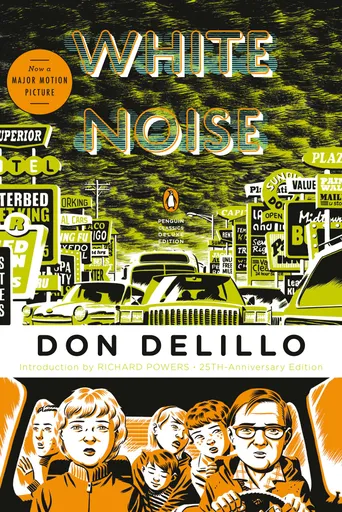
White Noise stars Jack Gladney, a family man and professor in a midwestern college town; he's the world expert in "Hitler studies," though his dark secret is that he does not know a lick of German. He lives a quiet campus life until a rail accident near his home results in a chemical spill that turns into a black noxious cloud, forcing an evacuation of the area. The resulting stresses bring to light issues that Jack has been avoiding: cracks in his family life, his work, and his life in general, or more specifically, the inevitability of his death.

High-concept, this is not (Pnin meets Twister?), but DeLillo is, if anything, a cracking prose stylist. White Noise is endlessly quotable, and it seems like every other page there is a line that you have to read again, just to enjoy the rhythm, the wittiness, the concision. It's hard to think of another writer that is so fun on a micro level. Unfortunately, when you zoom out, instead of seeing some coherent whole, you see a bunch of patchwork. Patchwork is fine––this is supposed to be one of the great postmodern novels, after all––but if you're trying to highlight some problems with modern society, as is clearly the case here, and fail to focus, it just won't hit.

The impression White Noise gives is that DeLillo started first with the social issues he wanted to discuss, then came up with a cast of "typical" characters that would work to illustrate his points. The fact that it comes off this way seems like an oversight, but OK, I can accept a premise and I don't always need relatable, realistic, or even interesting characters, nor a believable setting. But the farther we head into the world of make-believe, the more work it's going to take to feel the gravitas. There are many themes brought up––the anxieties of modern life, consumerism, the evils of technological development, the media landscape and disinformation, academic navel-gazing, self-medication––but none of these are really addressed beyond a few choice remarks, so I come away feeling like I've just overheard some annoying hipster rant about "the evils of society" from across the bar. It doesn't make me want to turn off the TV, it makes me want to tell them to shut up. Maybe it grinds my gears so much because I've given such a speech more often than I'd like to admit, before realizing that it helps no one, not even myself. Or maybe I'm just frustrated at the larger implication: if you all knew this back in 1985, how did things end up so much worse four decades later? Where are the works that carry it further? Where is the public backlash? Well, celebrating something like White Noise as some trenchant satire––a modern day Oscar Wilde!––is a brilliant way to make generations of critics impotent and co-opt their energies. Nothing sells on MTV better than an anti-MTV protest.

Maybe White Noise was too prescient, with the world in 2026 too close to what an author thought would be utterly ridiculous in the 1980s. Blended families, obsessions with death and legacy, and casual pharmaceutical use are too common to even comment on. Ads can be seen and heard everywhere, gambling companies openly sponsor sporting events, you can find hour-long video essays on just about every obscure pop culture reference, and influencers make places popular just for the sake of being popular. Serious study has been debased, and the equivalent of a Hitler scholar who can't understand German is sadly approaching the norm. Such observations may have been profound in 1985, but today, they are just tired premises employed by hack writers or worse, "content creators."

White Noise is still very much worth reading. It's funny in that cartoony absurdist way, and DeLillo's styling is so good that you'll find yourself following phrase by phrase until you reach the end. However, if you strip away the excellent prose, there's little to see here. Outside of the witty dialogue, the characters are boring––"Babette boobed boobiciously" is not far off from a character summary––the plotting is weak, and the shots it fires against even an easy target like contemporary academia just bounce off harmlessly. To me it shows just how much you can get away with a sequence of sparkling words. Even in the literary world, face card never declines.

KA+5
2 comments
User avatar fallback
tokyodrifter2 days ago

if you're trying to highlight some problems with modern society, as is clearly the case here, and fail to focus, it just won't hit

My thoughts exactly. I loved Underworld, but White Noise did absolutely nothing for me.

celebrating something like White Noise as some trenchant satire––a modern day Oscar Wilde!––is a brilliant way to make generations of critics impotent and co-opt their energies

One of my biggest criticisms of this novel is that if you're going to tell us the way we live sucks, you need to show us the alternative. Otherwise, you're just a whiner, no matter how much I might agree with you.

User avatar fallback
antiform16 hours ago

I feel this sentiment in my bones. But to give DeLillo some credit––and have the fire of a first reaction turn to the smolder of a second look––I wonder if a novel is a good way to present something like this. Do you know of any good examples where there were solutions posed? Ones that first come to mind are people like Rand, where the novels are kind of thinly veiled political philosophy works, but that's at the cost of the story and writing, IMO.

Does Underworld do this? I haven't read it, but I know it's also a "big issue" kind of novel. Perhaps all of DeLillo's works are, in some sense? It's hard to imagine something overtly social or political if Libra or White Noise are good representatives of his work, but I can see maturity or mastery leading to a better critique.