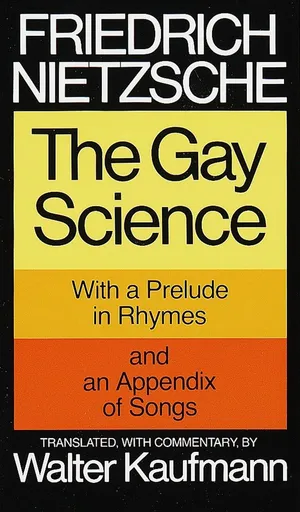

Rhymes and poetry are recurring motifs throughout The Gay Science, beginning with the Prelude in Rhymes. Section 84, "On the Origin of Poetry," recounts how ancient civilizations understood rhythm: songs could cast spells on demons, compel people to dance, or carry prayers to the gods. In the introduction, Walter Kaufmann emphasizes the difficulty of translating Nietzsche's verse. Preserving both the meaning and the meter is nearly impossible, and something is inevitably lost.
My knowledge of German doesn't extend much further than "ein Bier, bitte," but I would try to sound out the rhymes in both German and English, wondering whether I could feel a difference in the message. Later, in section 104, "Of the Sound of the German Language" Nietzsche writes about how Germans are becoming militarized in the very sound of their language, and how becoming accustomed to certain sounds profoundly shapes character. If the sounds that surround us help shape our disposition, then surely the sound we hear most often--our own name--must leave its mark as well. I remembered being told that a dog's name should begin with a hard consonant like "R", making it easier to catch the dog's attention and reinforce commands. Whether or not there's any truth to it, the idea lingered with me. If certain sounds really do have a profound effect on character, what effect did spending a lifetime answering to the name Friedrich have on Nietzsche?
In the footnotes to "Diverse Dissatisfaction" Kaufmann praises Nietzsche as a dialectical thinker, someone who refuses to see the world in black and white. That reminded me of learning about postformal thinking as a teenager. For whatever vain reason I had at the time, it convinced me that I always had to argue both sides of every issue. Later in my career, however, I discovered that if nobody holds strong (but flexible) opinions, everything grinds to a halt. Decisions dissolve into design by committee: endless meetings where nothing moves forward. Whenever I find myself fence-sitting, it is usually because I am indifferent, lazy, or simply out of my depth. My engineer's brain found particular satisfaction and partial justification for my opinion in section 189, "The Thinker":
He is a thinker; that means, he knows how to make things simpler than they are.
Excerpt from section 16, "Over the Footbridge":
There was a time in our lives when we were so close that nothing seemed to obstruct our friendship and brotherhood, and only a small footbridge separated us. Just as you were about to step on it, I asked you: 'Do you want to cross the footbridge to me?' Immediately, you did not want to any more; and when I asked you again, you remained silent. Since then mountains and torrential rivers and whatever separates and alienates have been cast between us, and even if we wanted to get together, we couldn't. But when you now think of that little footbridge, words fail you and you sob and marvel.
The image of the footbridge unleashed a torrent of thoughts. My first was why honesty is often easiest at the very end of a relationship. Once we know the relationship is over, petty grievances can finally be aired and true emotions made clear. On one such occasion, I realized that I had never fallen in love--I had simply learned to love her. That realization I kept to myself; there was no reason to wound her with it. But I admitted it to myself.
Then I thought about conversations with strangers. The absence of the footbridge lets you reveal parts of yourself that would feel out of place in a lasting relationship. Some of the most profound conversations I have ever had were with strangers--usually late at night, often helped along by two or twenty beers. By morning I would usually wonder whether I should reach out and turn that fleeting encounter into a friendship. I almost never did. It always felt as though the conversation belonged to that particular night, to that particular version of the two people having it. Whatever magic had existed could not survive being carried into ordinary life, and whatever deep and profound conversation we had had was already exhausted.
I also recognized myself in section 123, "Knowledge as More than a Mere Means," where Nietzsche observes that for some people boredom itself becomes the scientific impulse. Video games no longer excite me, and I have watched enough television for now. Books have become my primary source of entertainment. Because of that, I usually try to find something amusing in every book I read--even books that are serious or demand to be taken seriously. Strangely, I couldn't do it here. Whether it was the aphoristic style, the density of the ideas, or the subject matter itself, I can't quite say. I am beginning to think the ancients were right: there is a spell in rhythm, and Nietzsche cast it in the Prelude.
I expected pessimism. I expected fierce, polemical prose. What I did not expect was beauty.
One of my favorites, section 276, "For the New Year":
I still live, I still think: I still have to live, for I still have to think. Sum, ergo cogito: cogito, ergo sum. Today everybody permits himself the expression of his wish and his dearest thought; hence I, too, slass say what is to run across my heart this year--what though shall be for me the reason, warranty, and sweetness of my life henceforth. I want to learn more and to see as beatiful what is necessary in things; then I shall be one of those who make things beatiful. Amor fati: let that be my love henceforth! I do not want to wage war against what is ugly. I do not want to accuse; I do not even want to accuse those who accuse. Looking away shall be my only negation. And all in all and on the whole: some day I with to be only a Yes-sayer.
+ the color blocking on the cover is very pleasing in real life and the small font gave me a headache