STORE
search
⌘K
Explore
Salon
Quotes
Lists
Reviews
Writings
—
Changelog
About
Contact
Privacy
Donate
William Emerson | lit.salon
William Emerson
Born:
1701
Died:
1782
No bio available.
Add one in Open Library.
Born:
1701
Died:
1782
Books by William Emerson (50 max)
+ shelf
+ list
Cyclomathesis: or, An easy introduction to the several branches of the mathematics; being principally designed for the instruction of young students, before they enter upon the more abtruse and difficult parts thereof
1763
William Emerson, William Emerson, Charles Francis Adams Sr., John Quincy Adams
+ shelf
+ list
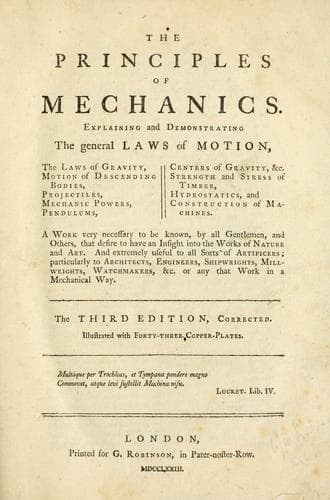
The principles of mechanics: explaining and demonstrating the general laws of motion, the laws of gravity, motion of descending bodies, projectiles, mechanic powers, pendulums, centers of gravity, &c. strength and stress of timber, hydrostatics, and construction of machines : a work very necessary to be known, by all gentlemen, and others, that desire to have an insight into the works of nature and art : and extremely useful to all sorts of artificers, particularly to architects, engineers, shipwrights, millwrights, watchmakers, &c. or any that work in a mechanical way : illustrated with forty-three copper-plates.
1758
William Emerson
+ shelf
+ list
The doctrine of fluxions: not only explaining the elements thereof, but also its application and use in the several parts of mathematics and natural philosophy.
1743
William Emerson
+ shelf
+ list
A system of astronomy.: Containing the investigation and demonstrations of the elements of that science.
1769
William Emerson
+ shelf
+ list
[Tracts: 1. The doctrine of combinations, permutations, and composition of quantities. 2. Chronology, or the art of reckoning time. 3. Calculation, libration, and mensuration. In four parts. Gauging, part five. 4. The art of surveying or measuring of land, in three sections; with an appendix, containing corrections and additions to the several foregoing volumes.
1770
William Emerson
+ shelf
+ list
The doctrine of fluxions not only explaining the elements thereof, but also its application and use in the several parts of mathematics and natural philosophy
1743
William Emerson
+ shelf
+ list
Navigation; or, the art of sailing upon the sea: Containing a demonstration of the fundamental principles of this art. Together with all the practical rules of computing a ship's way, ... To which are added, several necessary tables.
1755
William Emerson
+ shelf
+ list
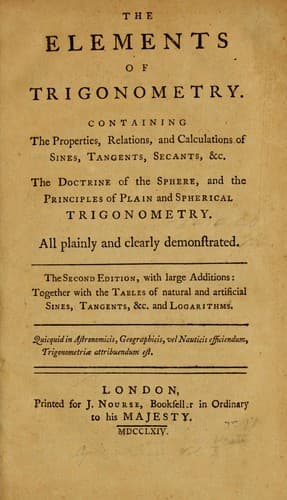
The elements of trigonometry: Containing the properties, relations, and calculations of sines, tangents, secants, &c. The doctrine of the sphere, and the principles of plain and spherical trigonometry. All plainly and clearly demonstrated.
1764
William Emerson
+ shelf
+ list
Treatise of algebra.
1764
William Emerson
+ shelf
+ list
The elements of optics.: In four books. Book I. Simple optics, or direct vision. Book II. Catoptrics, or reflected vision. Book III. Dioptrics, or refracted vision. Book IV. The construction of optical instruments ...
1768
William Emerson
+ shelf
+ list
The laws of centripetal and centrifugal force: shewing the motion of bodies in circular orbits, and in the conic sections, and other curves : and explaining the perturbating force of a third body, with many other things of like nature : being a work preparatory to astronomy, and the very basis therof, and absolutely neccessary to be known by all such as desire to be proficients in that science.
1769
William Emerson
+ shelf
+ list
A short comment on Sir I. Newton's Principia: containing notes upon some difficult places of that excellent book
1770
William Emerson
+ shelf
+ list
The art of surveying, or measuring land Containing, ...
1770
William Emerson
+ shelf
+ list
Chronology ; or, The art of reckoning time: Describing the several divisions of time in common use, the nature and original cycles and periods, and the most remarkable area's : and the manner of computing the numbers of such cycles, or the common notes, for any year ; the moveable feasts ; and the places of the sun and the moon ; and the nature of the calendar. Founded upon astronomical principles. To which is added a short chronological table
1770
William Emerson
+ shelf
+ list
The principles of mechanics Explaining and demonstrating the general laws of motion, the laws of gravity, motion of descending bodies, projectiles, mechanic powers, pendulums, centres of gravity, &c., strength and stress of timber, hydrostatics, and construction of machines ...
1794
William Emerson
+ shelf
+ list
The mathematical principles of natural philosophy
1819
Isaac Newton, Andrew Motte, William Davis, William Emerson, John Machin
+ shelf
+ list
The projection of the sphere, orthographic, stereographic, and gnomonical both demonstrating the principles, and explaining the practice of these three several sorts of projection
1749
William Emerson
+ shelf
+ list
The projection of the sphere, orthographic, stereographic and gnomonical: Both demonstrating the principles, and explaining the practice of these three several sorts of projection.
1749
William Emerson
+ shelf
+ list
The principles of mechanics. Explaining and demonstrating the general laws of motion. The laws of gravity, motion of descending bodies, projectiles, mechanic powers, pendulums, centers of gravity, &c. strength and stress of timber, hydrostatics, and construction of machines. A work very necessary to be known by all gentlemen and others that desire to have an insight into the works of nature and art, and extremely useful to all sorts of artificers; particularly to architects, engineers, shipwrights, millwrights, watchmakers, &c. or any that work in a mechanical way
1758
William Emerson
+ shelf
+ list
Method of increments: wherein the principles are demonstrated and the practice thereof shown in the solution of problems.
1762
William Emerson
+ shelf
+ list
The doctrine of proportion, arithmetical and geometrical: together with a general method of arguing by proportional quantities
1763
William Emerson
+ shelf
+ list
Cyclomathesis or, An easy introduction to the several branches of the mathematics. Being principally designed for the instruction of young students, before they enter upon the more abstruse and difficult parts thereof
1763
William Emerson
+ shelf
+ list
The method of increments: wherein the principles are demonstrated and the practice thereof shewn in the solution of problems
1763
William Emerson
+ shelf
+ list
A treatise of algebra in two books ...
1764
William Emerson
+ shelf
+ list
A treatise of algebra, in two books: Book I. Containing, the fundamental principles of this art. Together with all the practical rules of operation. Book II. Containing, a great variety of problems, in the most important branches of the mathematics.
1764
William Emerson
+ shelf
+ list
The nature and properties of curve lines.
1767
William Emerson
+ shelf
+ list
The arithmetic of infinites: and the differential method : illustrated by examples
1767
William Emerson
+ shelf
+ list
The elements of the conic sections.
1767
William Emerson
+ shelf
+ list
The arithmetic of infinities, and the differential method: illustrated by examples
1767
William Emerson
+ shelf
+ list
Arithmetic of infinites and the differential method: illustrated by examples.
1767
William Emerson
+ shelf
+ list
Perspective: or, the art of drawing the representations of all objects upon a plane: In two sections. ...
1768
William Emerson
+ shelf
+ list
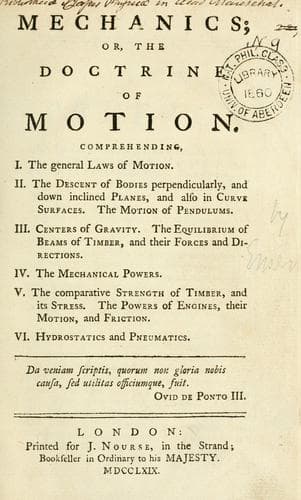
Mechanics, or, The doctrine of motion ...
1769
William Emerson
+ shelf
+ list
The projection of the sphere, orthographic, stereographic, and gnomonical. Both demonstrating the principles, and explaining the practice of these three several sorts of projection
1769
William Emerson
+ shelf
+ list
Mechanics; or, the doctrine of motion. Comprehending, I. The general laws of motion. II. The descent of bodies ... III. Centers of gravity. ... IV. The mechanical powers. V. The comparative strength of timber, and its stress. ... VI. Hydrostatics and pneumatics
1769
William Emerson
+ shelf
+ list
doctrine of combinations, permutations, and compositions, of quantities, clearly and succinctly demonstrated.
1770
William Emerson
+ shelf
+ list
Calculation, libration, and mensuration: or the arts of reckoning, weighing, and measuring. Being a mechanical work, adapted to the business and practice of tradesmen and artificers, in the shortest method possible; and designed purely for common use.
1770
William Emerson
+ shelf
+ list
Calculation, libration, and mensuration; or The arts of reckoning, weighing and measuring Being a mechanical work, adapted to the business and practice of tradesmen and artificers, in the shortest method possible; and designed purely for common use
1770
William Emerson
+ shelf
+ list
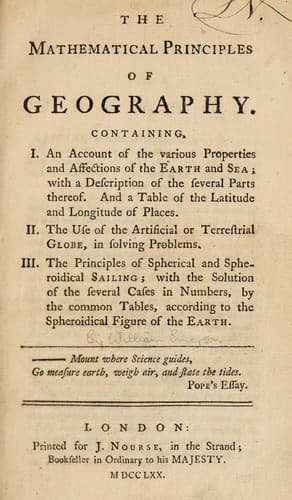
The mathematical principles of geography. Containing, I. An account of the various properties and affections of the earth and sea, with a description of the several parts thereof, and a table of the latitude and longitude of places, II. The use of the artificial or terrestrial globe, in solving problems, III. The principles of spherical and spheroidical sailing, with the solution of the several cases in numbers, by the common tables, according to the spheroidical figure of the earth
1770
William Emerson
+ shelf
+ list
Dialing: Or the art of drawing dials, on all sorts of planes whatsoever
1770
William Emerson
+ shelf
+ list
The mathematical principles of geography.
1770
William Emerson
+ shelf
+ list
A short comment on Sir I. Newton's Principia containing notes upon some difficult places of that excellent book
1770
William Emerson
+ shelf
+ list
Miscellanies. Or a miscellaneous treatise; containing several mathematical subjects
1776
William Emerson
+ shelf
+ list
The elements of trigonometry Containing the properties, relations, and calculations of sines, tangents, secants, &c. The doctrine of the sphere, and the principles of plain and spherical trigonometry. All plainly and clearly demonstrated
1788
William Emerson
+ shelf
+ list
Tracts: containing: I. Mechanics, or the doctrine of motion.: II.
1793
William Emerson
+ shelf
+ list
The elements of geometry: in which the principal propositions of Euclid, Archimedes, and others, are demonstrated after the most easy manner; to which is added, The doctrine of proportion, arithmetical and geometrical ...
1794
William Emerson
+ shelf
+ list
The elements of geometry, in which the principal propositions of Euclid, Archimedes, and others, are demonstrated after the most easy manner. To which is added, a collection of useful geometrical problems. ... By William Emerson
1794
William Emerson