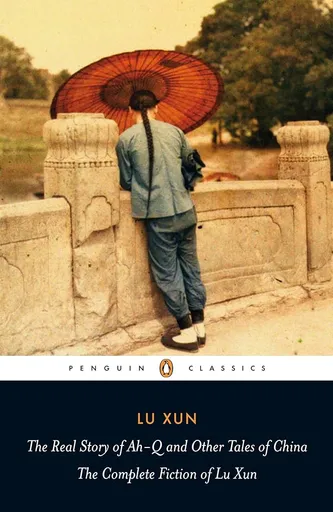

According to the intro, Lu Xun is one of the masters of "modern" Chinese literature, helping to introduce vernacular Chinese into the short story form and producing works of often-bleak social realism, and in light of both these traits, plus the wider movement towards "Western" liberalization and modernization that he participated in during the 1920s and early 1930s, it's no wonder he remains vital for many Chinese readers. The natural question: will a Westerner reading him in 2026 will get as much out him?
In a pinch, based off the stories in this collection, you could describe him as a kind of Chinese Chekhov. Like Chekhov (with whom he shared a medical background), he often writes sympathetically but clinically about "the idiocy of rural life": all the stagnation, cruelty, and immiseration of small towns under the sway of feudalism. You have a portrait of a nation where a neighbour might try to get you killed for failing to wear a queue or for failing not to wear one, where a desperate family wastes their money on snake-oil medicines for their dying child, and where people habitually seek reputational security by victimizing others. And like Chekhov, Lu Xun skilfully problematizes both too-easy indictment and too-easy compassion, so, e.g., the repellent, sycophantic title character Ah-Q still earns our compassion when he's carted off for an execution at the end of his story, while liberal intellectuals of the type Lu Xun himself was are indicted for their arrogant hatred of the peasants they presume to represent.
Chekhov with Lu is a fun comparison. I was unaware that Lu studied medicine; I had always heard he had your standard literary background (i.e. feckless failson), which seems more or less true from his wiki bio. I think a lot of the contrast can be attributed to the societies they came up in as riches-to-rags victims: Chekhov in the back half of Russia's Golden Age, Lu in the decaying Qing dynasty; Chekhov not living to see the October Revolution whereas Lu was caught up in the fervor of the May 4th movement; Chekhov could afford to be less overtly political in his work, Lu would likely be long forgotten had he done the same.
I think Lu's stories are interesting to think about from a modern perspective. What would he have thought of the Cultural Revolution and its aftereffects, which are still echoing and remain a wild spot to explore, even through a CCP-stamped work like The Three-Body Problem? Most Western cultures today are pointedly not ones that values traditionalism, yet many of the issues Lu pointed out a century ago persist. It seems to indicate that it wasn't traditionalism that was the problem, or at least, its resulting ills were merely symptoms, not the cause. The cannibalism in "Diary of a Madman" was meant at the time to be a metaphor specific to Chinese society at the time: a poor, weak, fractured nation ruled by a privileged minority with an iron fist. What is it saying when so many of us feel this way today?
If you haven't read them yet and would like to have more context for the issues brought up here, Lu's political stuff is also worth taking a look at. I like his speech The Old Song Has Already Been Sung, written in 1927, so Russia is specifically brought up as a point of comparison and has famous lines like "Chinese culture is the culture of serving the master, paid with the suffering of the masses" which maybe makes it clear why people as different as Mao and Ba Jin revered Lu.
Thanks for the tip about the political writings! And I also find the question of specificity to the Chinese context you raise very interesting (I first became interested in Lu Xun after reading a Fredric Jameson essay where he discusses Diary of a Mad Man and the difficulty of interpreting the story outside its historical/political context)