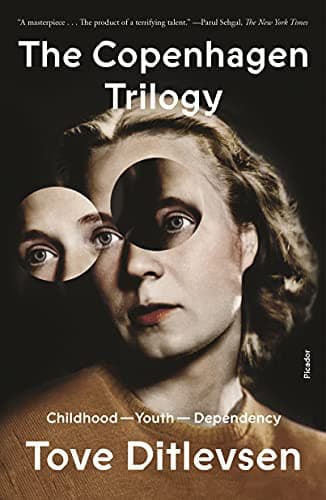
I brought this along on a trip to Thailand in the hopes of recreating the experience I had reading Ferrante's Neapolitan novels on a trip through Spain. Superficially Ditlevsen's memoirs promise something similar: a precocious, sensitive working class girl uses her gift for writing to escape her brutal, war-torn neighbourhood, join her intellectual peers, and form observations on class, gender relations, and generational debt along the way.
The Copenhagen trilogy delivers on something very different instead. I found in this book a complete reversal of almost every theme and narrative predicate in Ferrante's works. The cornerstone of the Neapolitan novels is the rivalrous friendship between Lila and Lenu. The ways their choices change their lives for better or worse. That they have support, patrons, opportunities, if only they can free themselves from the miniature, idiot world of their neighborhood to take them. In Copenhagen, no-one cares about young Tove. Her life is boring and unliterary. Her ability to write poems is illegible to the people around her. She isn't really concerned about the lives of her peers, nor are they concerned with hers, she doesn't have any real friends. She doesn't understand people, and does not feel understood. Her female condition is a mystery to her. Everyone is too selfish and drunk to give her any real assistance or leg up or even pay her the slightest attention. She gains a mentor, only to find one day his house destroyed and him disappeared. A poetry editor promises to publish her work when she is older, then dies before she becomes of age. And just as she turns eighteen, World War II starts.In the Neapolitan novels, the hypocritical position leftist men put women in is a recurring motif. Tove does meet a lot of men, and they keep getting her pregnant. No-one really seems sure of what to do about this. The men in her life are useless, drunk, retarded. They are not ambitious or handsome, they can't hold down jobs and they live with their parents. She does not have any great romance. It seems that even back then Scandinavians were unsentimental and crude about sex and love. Unlike Elena, Ditlevsen does not muse on the difficulties of being both a mother and a working artist. Instead she says: "to the abortion clinic... and step on it!!", speeding around Nazi-occupied Copenhagen in pursuit of the nearest doctor who'll yank it out of her. The child she does have she mostly ignores in a painkiller-induced haze.The last book in the trilogy is said to be one of the great portrayals of addiction. I do think it is. Ditlevsen does not climactically reach some rock-bottom. She does not at this point bear much trauma to speak of. She shacks up with a schizophrenic medical student and at some point realises she can make him give her free drugs on command (in exchange he rapes her as she's passed out). The war passes her by and does not really affect her besides somewhat frustrating her ability to Doordash drugs and abortions. She goes to rehab then relapses. Ditlevsen's life feels to her like a big waste. Instead of it forming a personal mythology, she's glad to be rid of her childhood. Her 20's are funerary: she counts the days like falling dust. She and her colleagues never seem to get anywhere or make anything of themselves. They swear they'll join the Resistance but never get around to it. This is a very different world to that of the Neapolitan novels, which seem premised on "work makes free" -- the characters are always at work, when faced with a predicament usually the solution lies in industry. If Elena gets distracted, she is punished in finding her colleague or old friend has in the meantime socially advanced. Here great pains are taken to present her life as a non-linear chronicle of things not started, opportunities gone cold, promises broken, disappointments, lost hours, numbness. She does get to briefly meet Evelyn Waugh.By the end of the third book, rather than wrestling with Fascist factory-owners or navigating the courts of the leftist avant-garde, Tove Ditlevsen is just trying to get through her day without passing by a pharmacy and giving in again. Like The Sopranos' Christopher, she has no arc.This is an anti-memoir, and I think anyone who has struggled with their unfulfilling life or an addiction (a boring one) will find something in this that they aren't finding in the typical memoir chronicling the rewarding life of the nurtured genius or requited romantic. What did any of it mean? There's no answer for that.
Anti-Ferrante

Aug 04, 2026