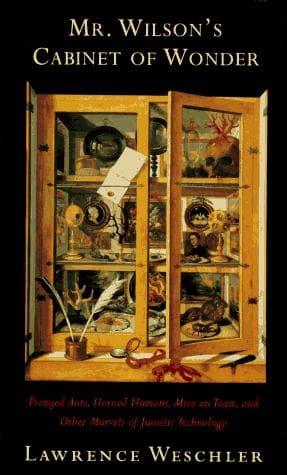

The Museum of Jurassic Technology (MJT)––the main subject of Mr. Wilson’s Cabinet of Wonder (1995)––is one of my favorite places in Los Angeles, if not the entire world. Located, oddly enough, in an unassuming storefront in Culver City on LA’s Westside between an Indian bodega (with delicious dosas) and a former real estate office, it is less a typical museum and more of a building-size interactive art installation with a museum's trappings: exhibits, labels, audiovisual guides, serious authoritative tone and all. A first visit makes a strong impression––those I've taken here have either loved it or passionately hated it––and the surreal, mind-bending feeling is unlike anything I've experienced elsewhere. I remember my own initial visit as the first time I acutely felt the permeability of the boundary between fact and fiction, at least in waking life.
To cast its spell, the MJT hearkens back to a world lost centuries ago, thousands of miles away. At surface level, it is an attempt to create a modern-day version of the Wunderkammer ("wonder room"). Before there were museums, there were these cabinets of curiosities, rooms displaying collections of loosely themed miscellanea by people of means or humanist scholars (often one and the same). In contrast to the clean division into natural history, art, and technology institutes seen now, these proto-museums presented natural marvels next to works of art next to feats of manmade ingenuity. Similarly, items of dubious provenance or value were often mixed in, a tail of a mermaid displayed next to a tail of a dolphin, a sea-unicorn-horn flute in the shape of Madonna and Child placed in front of a Dürer woodcut. While the aim, like modern museums, was to project power and sophistication, its medium was in evoking a sheer sense of wonder, a far cry from the sober, tempered response to a museum visit today. It is this feeling that this cabinet of wonder is calling back to.
The MJT is the lifelong passion project of David Hildebrand Wilson, an experimental filmmaker and special effects guru who has dedicated his energy, creativity, and personal finances to the museum since 1988. Indeed, the first half of the book is an unabridged version of a profile "Inhaling the Spore" that Weschler wrote about Wilson for Harper's magazine in 1994. It is well-written in that signature style, informative, and personal; something I'd happily put up against a Tom Wolfe or Gay Talese. The MJT is in many ways a takedown of museums, and if it were some ham-handed parody––a rebellious first-year art student project––it wouldn't be worth mentioning. However, like the best criticism, the MJT is also a celebration, even a love letter to museums as an institution. This requires a delicate maintenance of tone and content, to keep the knowing smile from degenerating into a smug smirk or strained grimace, and Wilson's dedication to the joke and clarity of vision shine through in the article as much as the MJT itself. You often see Wilson in the museum; on my last visit, he was playing the accordion in the second-story atrium. This atrium––a reproduction of the study of Nicholas II in the Winter Palace, complete with live doves (and back in the day, even a friendly borzoi)––is my favorite room of the MJT, worth the modest price of admission alone, in my opinion.
In the second part of Mr. Wilson's Cabinet of Wonder, Weschler steps back from the first to the third person, tracing the history of the Wunderkammer trend and providing context for its development. It doesn't hit the peaks of the first half––it mostly consists of a collection of quotes from scholarly secondary sources (which seem excellent) on the topic––but it's a pleasant enough romp through several disparate areas that this topic touches, including magical realism literature, the crimes underlying the acquisition of such treasures, the Enlightenment and concomitant rise of positivism, and the impact of the rediscovery of Chinese civilization by European society in the early 19th century.
Why did these wonder rooms arise so suddenly in Western Europe in the late 16th and 17th century? Why there? Why then? Here Weschler cites American historian Stephen Greenblatt's Marvelous possessions, which suggests that the discovery of the New World was the trigger: the fact that there was an entire continent, hitherto unknown, that was just there the whole time, full of things that they'd never seen before. What else could be there, just beyond our reach? Even a century and a half after Columbus's voyage, Europe was still reeling from discovery, and the idea is that Wunderkammer tapped into that sensibility. He also cites English historian Francis Yates's remarkable Giordano Bruno and the Hermetic tradition, which emphasizes the role played by the rise of hermeticism during the same time period, a complementary response perhaps, to this feeling of the ground moving beneath your feet. A fascinating question, but there are no conclusions presented here, only a series of witty words and pretty pictures, which at times felt like just padding to get the book to 150 pages.
You can read Mr. Wilson's Cabinet of Wonder before a visit to the MJT; you won't spoil yourself very much, as the museum has expanded considerably in the 30 years since the book's writing, and there is nothing about Wilson himself in the museum proper. You can read it after a visit, and maybe you'll need it, to center yourself after the disorienting experience and take in what exactly it is that you saw, so that you're not just walking around with a "WTF?!" thought bubble above your head. You can even read it if you're not planning to visit the MJT; it's a short and pleasant read and a dive into the chaos from which the modern institution of the museum arose. But it's really worth visiting in-person, especially if you care at all about visual arts or "knowledge" as a cultural concept or want to experience something truly unique.
Mr. Wilson is now 80 years old, and what he has poured into the Museum of Jurassic Technology has resulted in something that is nothing short of marvelous. It gives me hope that art today can be more than just a glitzy barnacle on the side of global finance. I want to live in a world where others can do what Wilson did; not for fame, not for riches, but because he felt a kind of calling (briefly recollected in the profile) to bring to people what came to him as an invisible glimmer, never wavering in spite of the many difficulties he encountered along the way. Maybe that's not our world, but people like him are resplendent examples of what is possible.
I [Weschler] mentioned the Talmudic story of the Thirty-six Just Men––how at any given moment there are thirty-six ethically just men in the world, unknown perhaps even to themselves, but for whose sake God desists from utterly destroying the shambles we have made of His creation. Maybe, I suggested, there are thirty-six aesthetically just men as well.
David looked at me, authentically non comprehending. “I don’t understand the difference,” he said.
He was quiet a few moments, and once again the ironylessness seemed momentarily to crack. “You know, certain aspects of this museum you can peel away very easily, but the reality behind, once you peel away those relatively easy layers, is more amazing still than anything those initial layers purport to be. The first layers are just a filter.”
If there's any justice to the selection of that (aesthetic) Thirty-six, it's got to include David Hildebrand Wilson.