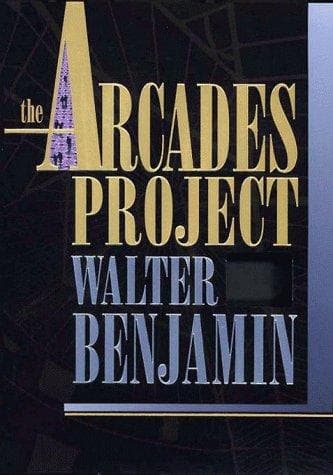
It’s called dialectrics, sweaty

Aug 02, 2026
“Perhaps the most deeply hidden motive of the person who collects can be described this way: he takes up the struggle against dispersion. Right from the start, the great collector is struck by the confusion, by the scatter, in which the things of the world are found.” -Walter Benjamin
“The reader […] of the Arcades Project […] may think he is, in the end, faced with ruins rather than with virginal building materials. What Benjamin wrote about German Trauerspiel however, holds true for the Arcades Project; namely, that ‘in the ruins of great buildings the idea of the plan speaks more impressively than in lesser buildings, however well preserved they are.’” -Rolf Tiedemann, editor of The Arcades Project.
It feels wrong to try to summarize this book or try to synthesize something out of it. I mean, I’m obviously going to but, on its face The Arcades Project is a monument against the idea of history as an individual writing about the past.
Here history is a heap of crumpled receipts, newspaper clippings, and advertisements arranged in a collage. It’s gothic cathedral spires giving way to cast iron and glass train stations. It’s paintings of strange eyeballs floating through black mirror worlds. It’s occult undercurrents that move through books that come awake and discover new depths of the human psyche. Walter Benjamin throws all of these materials into the pot and augurs the future. The result he achieves is a new understanding of history. One where the present is not merely an embarrassed backwards vision of some progressive future, but a bomb made from the gathered fissile potential of the past, waiting to explode into a better world if only our attention and memory can wake up and interpret the dream of history.
The hand of the author is light, but it’s omnipresent. Benjamin died before The Arcades Project was ever structured into its final form so we’re left with a series of notes and references that he was able to gather over the last two decades of his life. And his ghost moves our attention around the ouija board, guiding us from one facet of Victorian culture to the next. It’s clear from the size of the tome that I’ve been lugging around with me for the past few months that his curiosity is nearly limitless in this pursuit. Nothing in the world of fin de siècle Paris seems to escape his eye. His quotes and brief inferences are scrawled with a really beautiful sort of hunger throughout the whole. He seems possessed by the importance of every minor detail and it all demands cataloguing.
Benjamin is self-aware too. Passages in the book seem like self-psychoanalysis where he tries to tease apart the meaning and justification for undertaking this project. One particular passage that gives some insight into Benjamin’s view of himself and his project is an excerpt he takes from Paul Bourget who writes about Maxine Du Camp’s inspiration for his book on Paris: Ses organes, ses fonctions, et sa vie dans la seconde moitié du XIX siècle.
“It was, for the writer, one of those moments when a man who is about to leave youth behind thinks of life with a resigned gravity that leads him to find in all things the image of his own melancholy. The minor physiological decline which his visit to the optician had just confirmed put him in mind of what is so quickly forgotten: that law of inevitable destruction which governs everything human […] He clearly perceived the possibility of writing about Paris this book which the historians of antiquity had failed to write about their towns.” -Paul Bourget
Benjamin empathizes with the figures of the nineteenth century along with documenting them. By far the longest meditation in The Arcades Project is on Charles Baudelaire, the brooding French poet and author of Le Fleurs du Mal, a psychedelic collection of poems about urban life in nineteenth century Paris. Benjamin comes back, again and again in his notes, to the character of the flâneur, a trope popularized in Baudelaire. The flâneur is a man borne of Victorian urban expansion who is good for exactly two things: walking, and observing.
There’s a whole host of historical implications of the focus on this character including the introduction of the detective novel and a general shift toward Realism. And Benjamin spends a lot of time comparing and contrasting the flâneur, the collector, and the allegorist. The interplay between the three is a bit jumbled and it’s hard to glean whether Benjamin views any of these characters positively. But he must relate with all three of them to some degree given that he spent most of his life observing urban culture and thinking about its history.
Perhaps the key to his feelings lies in the tangibility of creation and the physical nature of the collection that strips objects from their daily use. Implicit in The Arcades Project is the understanding that collections are precarious things. We have to be careful with the instincts that move us toward collection as our hoards of wealth and information and curiosities are not all created equal. There is the hoard of gold trinkets, gathered and buried in a bog before local catastrophe. There is the wunderkammer. There is the menagerie. But there is also the World Exhibition. The arcade. The shopping mall. The 500+ Google Chrome tabs hoarded over the course of reading Walter Benjamin’s swan song? Our collections can pollute and turn to spectacle or phantasmagoria if we don’t ground them in the real world or allow them to kindle our curiosity. History can be a tapestry left to the moths in a basement. Or it can be a magic lantern show drawing out attention away from the atrocities at the center of the room. Benjamin is acutely and ironically aware of this danger.
“Humanity will be prey to a mythic anguish so long as phantasmagoria occupies a place in it.”
But history can also be a collaborative collage that captures the world as it was. Voluntary memory can be a comfortable fiction, but involuntary memory triggered by a detail that just barely escaped historical annihilation can unlock the true past.

This book paints a pretty vivid picture of the race for a polio vaccine particularly with the competition between researchers to find a safe, effec...
I read Meditations by Aurelius about a decade ago, before the bastard Ryan Holiday ruined all discussion around Stoicism. Firsts are always special...
Watch What You Hear: Penelope's Dream of Twenty Geese (2020), like many of the most interesting works of the 21st century, was published pseudonymo...