
If you discovered something that could change the world, but with a potential for dramatic abuse, what should you do? Pretend you didn't find it, maybe even cover your tracks so that others can't follow? Tell people all about it, damn the consequences, as information should be free? Maybe something intermediate: record it, but lock in away in some vault, in case you might need it in the future? What would be better for you? What would be better for everyone?
Not the kind of decision most of us think about every day, but society would likely be better were that not the case. More pointedly, chemical and nuclear weapons, the advertising industry, surveillance technology, modern opioids, and the attention-maximizing algorithms of social media are among the discoveries that come most easily to mind when thinking of massive consequential downsides, and revolutionary new developments like gene editing or the contemporary form of "artificial intelligence" have the potential to trend that way as well. Should their inventors have buried such work, or at least kept it from being released to the world at large?
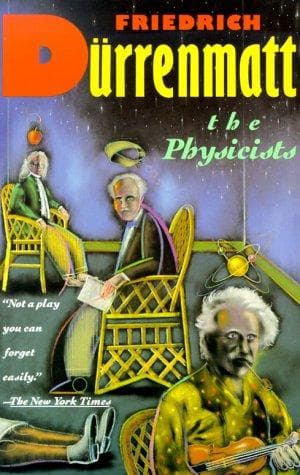
The Physicists (1964) is a dark tragicomedy, written in the thick of the Cold War, that tries to explore this issue in dramatic form. Dürrenmatt is a philosophically-minded Swiss playwright who was among the best-known proponents of epic theatre, an artistic movement that aimed to make the audience think about the situation being presented, rather than just identifying with a character. Unsurprisingly, many writers of epic theater were politically motivated, especially Bertolt Brecht, its most famous adherent. The Physicists is not overtly political, but its focus on physicists is a deliberate choice, as it is the intellectual responsibility of the profession that is played for its effect.
The setting is a posh insane asylum in idyllic Germany, or more specifically, the drawing room of a shared suite within one. All action is presented here. (Despite its name, epic theater arose as a reaction against the excesses of early 20th century theater and so sets tend to be spare.) The main characters are three physicists: one who thinks he's Isaac Newton, another who thinks he's Albert Einstein, and a third who claims to have been visited by King Solomon. The play opens with the death of a nurse, apparently killed by "Einstein," who seems undisturbed, calmly playing the violin in the adjacent room. Why did he kill her? What is to be done? How will the authorities, the sanatorium's staff, the others physicists react to such a tragedy?
The play unfolds at a brisk pace. There are no scene breaks, few descriptions, just two acts of breakneck action and dialogue, interrupted only by a climactic action that is simultaneously unexpected yet seemingly inevitable. The first act carefully sets up the dominos, and in the second we watch how they tumble in intricate patterns. The third physicist is named Möbius, no coincidence there either, as it in in him that apparent opposite sides are seen to be one and same, per the eponymous strip. To go into much more detail would spoil the effect, but I found myself drawn to how the ethical questions alluded to above were explored, eagerly following the twists and turns, and even surprisingly moved by the concluding lines.
The Physicists is apparently a popular work in German-speaking countries (the original play is in German), often a part of high school literature classes and performed by theater groups. There are likely practical reasons for this, but I think it is also particularly great at presenting many nuances of the relevant questions in a concise way. Something more straightforward like a panel discussion on ethical responsibilities of nuclear physicists is but a roundabout way to get to the heart of the matter in comparison. The conclusion is brutal and memorable, and picking apart the right and wrongs of the characters is thrown out as a challenge. As for what Dürrenmatt thought himself, we have the following from the "21 Points to The Physicists" that he appended to the end of the print edition:
16. The content of physics is the concern of physicists, its effect the concern of all men.
17. What concerns everyone can only be resolved by everyone.
18. Each attempt of an individual to resolve for himself what is the concern of everyone is doomed to fail.
In doing so, Dürrenmatt alludes to potential of hope in light of the play's conclusion: if a problem concerns everyone, everyone needs to be part of the solution. But understand that this is no pithy statement, no facile declaration that the democratic solution is best. Ethical choice here does not rest solely on the scientist, nor any other authority, nor must it be left to the masses to decide. Instead, look closely, for an absence, not a presence, in our fated characters. The dignity of the individual, the sanctity of life, love for your fellow man; without such considerations––and the presence to keep them in mind amid the excitement––we are doomed to split and sever as the kingdoms following King Solomon, who in his relentless pursuit of gain, overcame even his own prodigious wisdom, and turned away from God.